Company · New York, New York
Monumental Labs
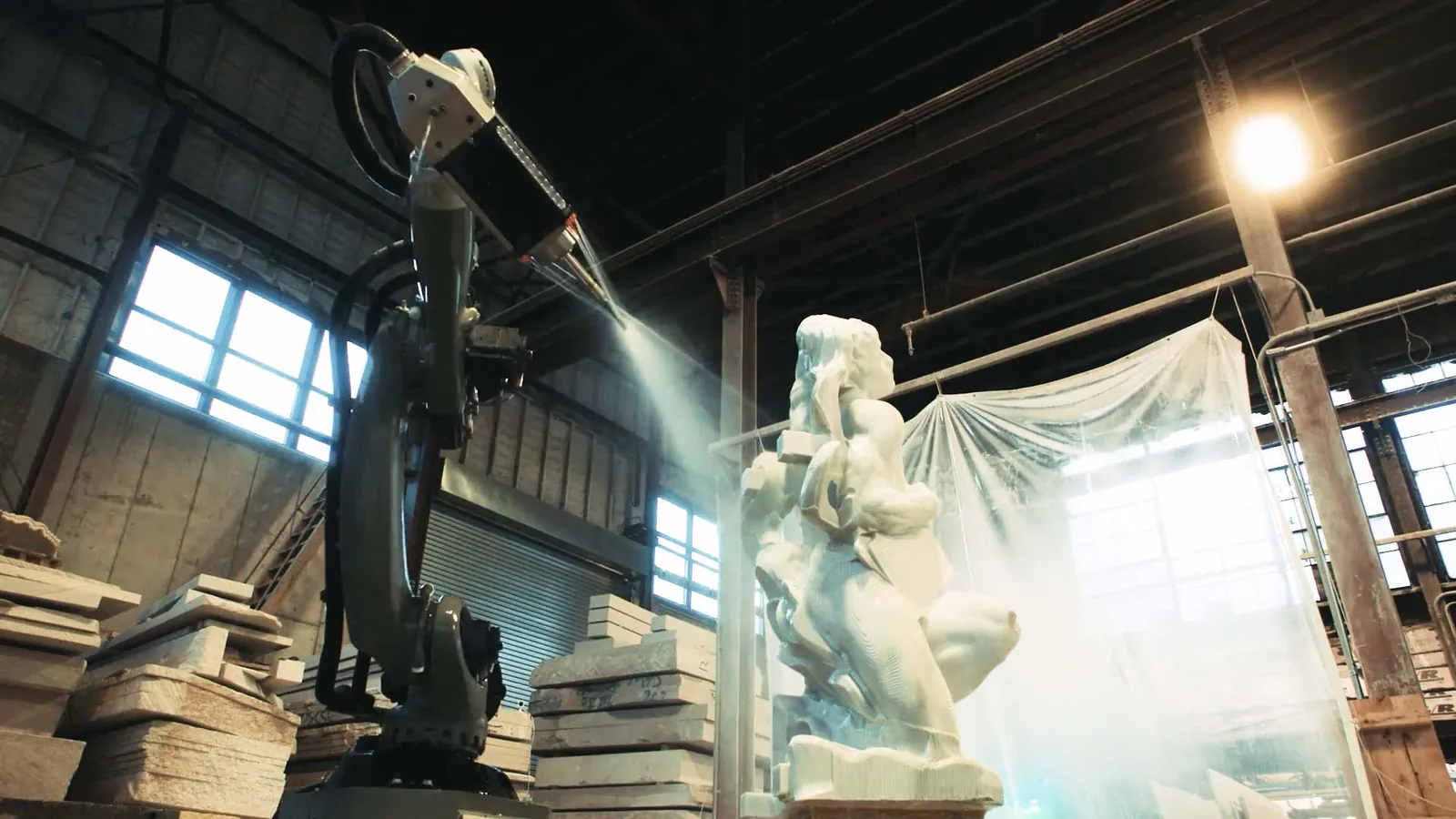
A robot can rough out a Corinthian capital. It cannot yet give the stone its final sharp edges and subtle surfaces. At Monumental Labs, machines do the heavy cutting and carvers take over where the tools reach their limits. The division of labor is an attempt to make architectural ornament viable for more buildings.
For three balconies at Manhattan’s Villard Houses, the challenge began before anyone touched the sandstone. Weather had worn away much of the original ornament. Monumental studied historic photographs and the building’s surviving decorative patterns to reconstruct what it could. The firm is candid that some details are informed interpretations. Robots milled the replacement panels; stone carvers completed the surfaces by hand.
At the Frick Collection, the workshop produced more than a hundred carved modillions, six rosettes and a replacement capital, among other repairs. Its portfolio also includes work for Carnegie Hall. These commissions are part of its completed restoration portfolio.
The process starts with a drawing, scan or model. Fabricators choose stone and plan tool paths for multi-axis milling equipment. Large cutting tools remove the bulk of the material; finer bits approach the intended surface. Human carvers then resolve undercuts, crisp corners, tool marks and finish. In a February 2026 interview with Architectural Record, founder Micah Springut explained that programming these tool paths, and keeping the robots working rather than idle, is an important cost bottleneck.
Springut has offered an illustrative comparison: a large Corinthian capital that might cost $90,000 to carve entirely by hand could cost roughly $30,000 with robotic assistance. That is his estimate, not a published independent price survey. Monumental is also developing reinforced structural-stone systems, for which it advertises major cost and carbon advantages. Those claims should be assessed separately from the restoration work the firm has already delivered.
What the robots change
Robotic rough-cutting can reduce the hours a skilled carver spends removing bulk material. The remaining work still depends on the carver’s eye and hand. Whether this makes carved ornament common in ordinary construction depends on pricing, installation, demand and repeatable delivery.
Key facts
- Founded in 2022 by Micah Springut, according to Architectural Record.
- Uses digital modeling, multi-axis robotic milling and hand finishing.
- Completed projects include carved stone for the Villard Houses, Frick Collection and Carnegie Hall.
- Springut described a $90,000 versus $30,000 example for one large Corinthian capital; this is a company estimate, not a market-wide benchmark.
- Reinforced structural-stone buildings are a development goal, not an established delivered-building product.