Place · Vineyard, Utah
Utah City
For much of the twentieth century, the land beside Utah Lake belonged to Geneva Steel. The mill closed in 2001. Now developers are trying to turn a vast former industrial site in Vineyard into something the city has never had: a downtown.
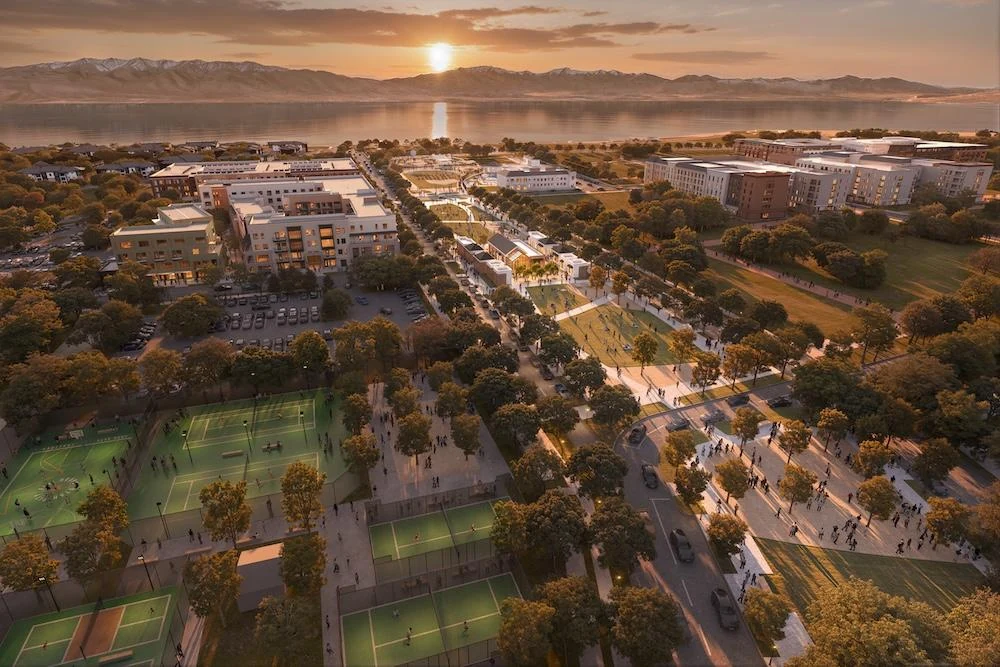
Geneva Steel was built during World War II and became a fixture of Utah Valley’s industrial landscape. After its closure, the site left behind a rare opportunity in a fast-growing region: hundreds of acres near a commuter rail station and the lake. Utah City’s developers propose a roughly 700-acre district of housing, workplaces, shops, parks and streets.
The first phase is more than a set of drawings. The 120 Bend and 220 Bend residential buildings have brought apartments to the property. Bella’s Market opened in November 2025, providing an everyday destination for early residents. The Greenline, a planned 12-acre public-space corridor, is intended to connect the Vineyard FrontRunner station toward Utah Lake through paths, parks and recreation space.
Some of the most consequential construction is underground. Utah City is developing a shared heating-and-cooling network with Corix, rather than leaving every building to operate a wholly separate system. The first customers began receiving service in September 2026. Future extensions could exchange heat among buildings and make use of nearby industrial waste heat, but those larger benefits depend on how the network expands.
The next test is whether the district acquires the institutions and everyday activity of a downtown. A Huntsman Cancer Institute campus is under construction, and the proposed Broad Street district would bring more retail and entertainment. Those plans need to be distinguished from the housing and businesses already operating.
Public money is part of the picture. Vineyard has approved financing mechanisms intended to help deliver infrastructure around the new development and rail station, while some local officials have questioned the scale and terms of that support. That debate matters because streets, utilities and public spaces must be paid for long before a new downtown is fully occupied.
Utah City has places to live, shop and catch a train. Whether those pieces grow into a coherent, walkable downtown will become clearer as blocks fill in and more of the promised public realm opens. The former steel mill offers enough room to build a city center. The harder part is making it function like one.
Key facts
- Vineyard, Utah, on the former Geneva Steel property beside Utah Lake.
- Master-planned district of approximately 700 acres.
- Vineyard FrontRunner commuter rail station serves the development area.
- Early residential phases include 120 Bend and 220 Bend.
- Bella’s Market opened in November 2025.
- The Greenline is planned as a 12-acre public-space corridor.
- Corix district heating and cooling began serving initial customers in September 2026.
- A Huntsman Cancer Institute campus and further mixed-use phases are under development or planned.
Further reading
Related on BUILDPLACES
- Culdesac ( Explore )
- Tax Increment Financing ( Explainer )
- Brownfield Redevelopment ( Explainer )