Organization · Sonoma County, California
Watch Duty
Watch Duty began with a maddening experience: cofounder John Mills could see firefighting aircraft near his Northern California home but could not find a clear account of what was happening. He discovered that local radio listeners were already piecing together updates for their neighbors. With volunteer engineers and reporters, he helped turn that informal effort into a public-safety service in about eighty days. Five years later, the nonprofit’s maps and alerts are used by millions across the country.
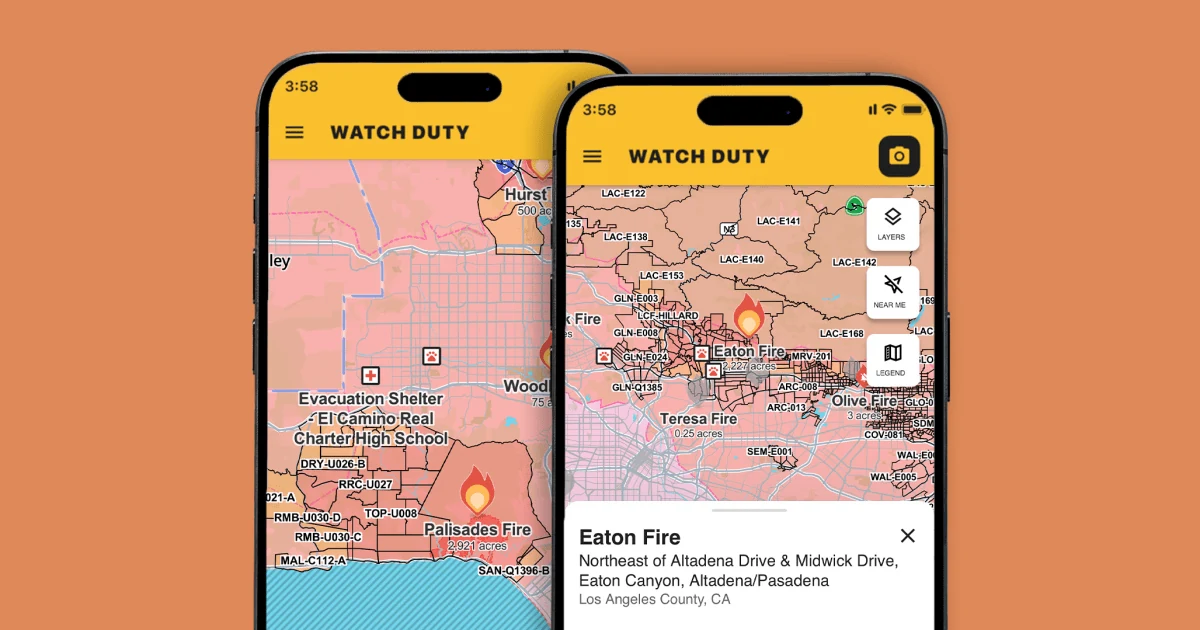
Watch Duty relies on a network of people behind the map. Active and retired dispatchers, firefighters, emergency personnel, journalists, and trained volunteers follow radio traffic, agency updates, cameras, and other public information. Reporters verify developments and write updates that residents can understand. The reporting operation uses software that helps the team find the signals worth checking.
That reporting model solves a practical problem. During a fast-moving fire, relevant information may be scattered among dispatch channels, agency notices, and separate mapping systems. Watch Duty organizes it around an incident and a location, with notifications reserved for serious threats to life or property. Its information helps people understand events around them, while official authorities remain the source of evacuation orders.
The network has grown far beyond its Sonoma County beginnings. The nonprofit says it now covers all fifty states, and its 2026 newsroom figures report more than sixteen million yearly active users. The free public service is part of its identity. Watch Duty has also built tools and partnerships for professional organizations that need reliable disaster intelligence.
In June 2026, Watch Duty expanded its reporting to major floods. It brought the same combination of public data, experienced reporters, and careful notifications to a second kind of disaster. That expansion says something about the organization: it has built a reporting system capable of taking on problems beyond the emergency that prompted its founding.
Watch Duty is compelling because its founders turned an urgent local need into a nationwide public-safety service. People need trustworthy information when their homes are in danger. A group of residents, first responders, and technologists decided to organize themselves around providing it, and then kept building until the service operated nationwide.
Key facts
- Founded in Sonoma County in 2021 as a nonprofit emergency-information service.
- Provides real-time reporting and mapping for wildfires and major floods in all 50 states.
- Reports are verified by a network including active and retired first responders, dispatchers and trained volunteers.
- Reported 16 million-plus yearly active users in its 2026 newsroom figures.
- Expanded its incident reporting to major flooding in June 2026.