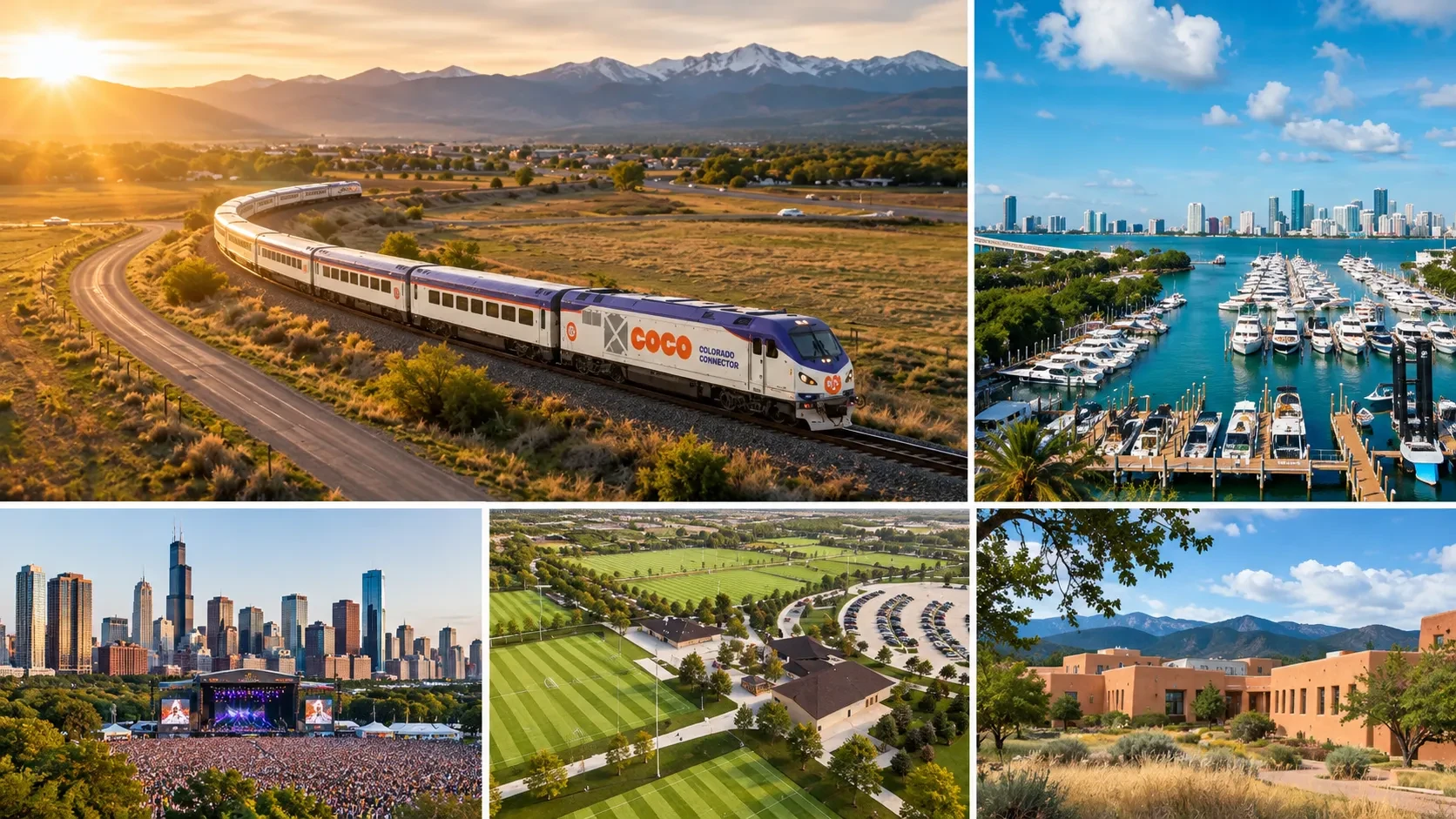
Read the original 15-measure Election Day roundup ↗
Yesterday, we looked at 15 ballot measures that could influence what gets built across the United States. Some involved hundreds of millions of dollars in infrastructure investment. Others concerned relatively small changes to the rules governing housing, public property, and development.
And results have started to come in.
Colorado’s proposed passenger railroad is moving closer to reality. Bay Area voters have backed a major new source of transit funding. Austin and Charlotte approved substantial investments in public facilities and infrastructure. And in St. Petersburg, Florida, voters authorized up to $600 million for improvements intended to protect the coastal city from flooding and storms.
Other communities rejected proposals to redevelop public property or allow taller buildings.
Here are the clearest results so far, and what they mean for the projects involved.
Results reflect returns available November 4, 2026. Vote totals remain unofficial until certified.
Colorado votes to bring passenger rail back to the Front Range
Colorado | Ballot Issue 7A
PASSED · Approximately 56% Yes in early returns
A passenger railroad connecting Colorado’s fast-growing Front Range has been discussed for decades. On Tuesday, voters across the proposed service area backed a dedicated funding source that could help turn those plans into reality.
Issue 7A establishes a 0.333% sales and use tax expected to generate approximately $295 million annually. It also authorizes up to $580 million in borrowing, with a repayment cost of up to $785 million.
The money will support Colorado Connector, or CoCo, a passenger rail service planned to connect Fort Collins, Loveland, Longmont, Boulder, Denver, Colorado Springs, Pueblo, and communities in between.
The initial northern service between Denver and Fort Collins is already being developed through existing transportation partnerships, with service targeted for 2029. The newly approved funding would help expand the service, including additional trips and connections south of Denver.
The railroad would provide an alternative to driving along the heavily traveled Front Range corridor, where population growth has placed increasing pressure on Interstate 25 and the surrounding transportation network.
The vote establishes a substantial local funding source. The district still faces engineering, construction, and coordination with existing freight and passenger rail operators before the full proposed system can begin operating.
Bay Area voters approve nearly $1 billion annually for public transit
San Francisco Bay Area, California | Regional Transit Measure (RTM)
PASSED · Approximately 61.5% Yes in preliminary returns
Voters across five Bay Area counties backed a regional sales tax expected to generate approximately $980 million annually for public transportation.
The measure provides a new source of funding for some of the country’s largest transit systems, including BART, Muni, Caltrain, and AC Transit.
The 14-year measure increases sales taxes by 0.5 percentage points in Alameda, Contra Costa, San Mateo, and Santa Clara counties, and by one percentage point in San Francisco.
Much of the revenue will support transit operations, helping agencies maintain service as they contend with substantial budget deficits. The measure also provides funding for improvements to the passenger experience and other local transportation priorities.
The vote comes at a consequential moment for Bay Area transit. Federal pandemic assistance has expired, ridership patterns have changed, and several major operators have warned that they could face significant service reductions without additional revenue.
For the Bay Area, the immediate effect of the measure is expected to be preserving and improving existing transportation networks rather than building an entirely new system.
The funding also creates a longer-term financial foundation for agencies that connect millions of residents to jobs, schools, and neighborhoods throughout the region.
Miami rejects an $80 million redevelopment of Virginia Key’s marinas
Miami, Florida | Referendum 3
REJECTED
Miami voters rejected a proposed long-term lease and redevelopment agreement involving approximately 27.62 acres of publicly owned waterfront property on Virginia Key.
The proposal would have authorized a private developer to invest approximately $80 million in improvements to the Rickenbacker and Marine Stadium marinas.
The redevelopment plans included boat storage, restaurants, retail uses, and public parking.
In exchange, Virginia Key, LLC would have received an initial 45-year lease with two potential 15-year extensions. The agreement included approximately $204 million in guaranteed rent over the initial term, plus a share of gross revenues.
The vote prevents that particular lease agreement from moving forward.
Virginia Key remains one of Miami’s most significant waterfront areas, home to public recreation facilities, marine infrastructure, and the historic Miami Marine Stadium. The result leaves the city to determine whether and how to pursue another arrangement for the marina properties.
Austin approves $295 million for parks, pools, and libraries
Austin, Texas | Propositions A and B
BOTH PASSED · Approximately 61% Yes
Austin voters approved two bond measures totaling $295 million for improvements to the city’s parks, recreation facilities, and public libraries.
The larger measure authorizes $260 million for parks and recreation, while the second provides $35 million for library facilities.
The parks package includes $65.5 million for recreation buildings and facilities, $65 million for parkland improvements, $65 million for aquatic facilities, $29.5 million for infrastructure, and $35 million for land acquisition.
Among the identified projects are improvements to existing neighborhood parks, trails, recreation centers, and municipal pools. The land acquisition funding could also help Austin expand its park system in areas where access to public green space is limited.
The library package includes $20 million for renovation and expansion of the Hampton Branch at Oak Hill and $15 million for planning and development of a future library in Colony Park.
Austin has identified billions of dollars in capital improvement needs across its public facilities. The approved measures will address a portion of that backlog.
City staff will now begin coordinating the bond program, with more detailed project and spending information expected in early 2027.
Charlotte approves $425 million for transportation, housing, and neighborhoods
Charlotte, North Carolina | Three bond questions
ALL THREE PASSED · Approximately 62–67% Yes
Charlotte voters approved three bond measures totaling $425 million, authorizing new investments in transportation infrastructure, affordable housing, and neighborhood improvements.
The largest measure provides $280 million for transportation projects. Another $125 million will support affordable housing, while $20 million is designated for neighborhood improvements.
The transportation funding will support roadway improvements, intersection reconstruction, sidewalks, bicycle infrastructure, and other projects intended to improve mobility throughout the growing city.
Among the projects identified in the city’s capital plans are improvements to Bryant Farms Road and the Ashley Road, Freedom Drive, and Tuckasegee Road intersection.
The housing measure is Charlotte’s largest housing bond to date. It will support the city’s Housing Trust Fund, which works with public, private, and nonprofit partners to develop and preserve housing for low- and moderate-income households.
The neighborhood funding can be used for sidewalks, drainage, streets, lighting, and public spaces.
Charlotte has planned to repay the bonds through existing revenue sources without a proposed increase in the property tax rate. Individual projects will still move through design, procurement, and construction.
Coronado rejects a fourth story for multifamily buildings
Coronado, California | Measure D
REJECTED · Approximately 79% No in early returns
Voters in Coronado rejected a proposal to allow certain multifamily buildings to reach four stories and 42 feet in height.
The city’s existing limit in the affected R-4 residential district is three stories and 35 feet.
The proposed change would have allowed an additional story in an area already zoned for multifamily housing.
City officials had connected the measure to Coronado’s obligations under California housing law, which requires municipalities to plan for a specified number of homes at different income levels.
The proposal would have increased the amount of housing potentially accommodated on qualifying properties without requiring a broader expansion of the city’s residential development footprint.
Its rejection leaves the local height restriction unchanged.
Coronado’s underlying housing planning obligations remain, meaning the city may still need to consider other regulatory changes to satisfy state requirements.
Omaha approves $185 million for parks and public facilities
Omaha, Nebraska | Two bond questions
BOTH PASSED · Approximately 70–75% Yes in early returns
Omaha voters approved two bond measures totaling $185 million for parks, recreation facilities, and municipal buildings.
The first authorizes $30 million for parks and recreation. The second provides $155 million for public facilities.
A principal project in the parks package is the proposed redevelopment of Tranquility Park, a large recreational complex in northwest Omaha.
The improvements could include upgrades to athletic fields, restrooms, concessions, parking, and pedestrian infrastructure.
The public facilities measure includes funding for a proposed joint police and fire headquarters at the former Crossroads site.
The facility would consolidate certain public safety functions and replace aging municipal infrastructure.
The city has indicated that the bonds can be financed within its existing property tax levy. The approvals provide borrowing authority, with design and construction decisions to follow through Omaha’s capital planning process.
Baltimore County makes its urban growth boundary harder to change
Baltimore County, Maryland | Question A
PASSED · Approximately 72% Yes in early returns
Baltimore County voters approved a charter amendment that raises the number of County Council votes required to adjust its Urban-Rural Demarcation Line.
The boundary, commonly known as the URDL, has shaped development in the county for decades by distinguishing areas intended for urban growth from much of its rural landscape.
Before the amendment, five of nine council members could approve certain Planning Board-recommended changes to the boundary.
The new requirement is six votes.
The amendment does not move the boundary or directly authorize or prohibit a particular development.
It changes the political threshold for future adjustments, potentially making it more difficult to expand the areas where urban-scale development and infrastructure are permitted.
St. Petersburg approves $600 million for coastal resilience
St. Petersburg, Florida | Referendum Question 1
PASSED · 73.94% Yes in unofficial returns
St. Petersburg voters approved up to $600 million in general obligation bonds to help finance major improvements to the city’s stormwater, wastewater, and drinking-water systems.
The measure will support St. Pete Agile Resilience, or SPAR, a citywide infrastructure initiative focused on flooding, storm protection, and the reliability of essential utility systems.
The program includes drainage improvements, stormwater pumping stations, flood protection infrastructure, wastewater treatment upgrades, and drinking-water system improvements.
The investment comes as St. Petersburg confronts the consequences of heavy rainfall, coastal flooding, and hurricane exposure.
For a city built on a peninsula between Tampa Bay and the Gulf, managing water is a central infrastructure challenge. Flooding can disrupt roads, damage homes and businesses, and overwhelm the systems that collect, treat, and move water throughout the city.
The referendum authorizes the city to issue bonds in multiple series, with repayment through property taxes over periods of up to 30 years.
It does not require St. Petersburg to borrow the entire $600 million immediately, nor does it establish a final construction schedule for every project.
The vote gives the city a significant financing mechanism for an infrastructure program that will unfold over many years.
Explore St. Petersburg’s SPAR program
A few results we’re still watching
Several other measures from yesterday’s article remain unresolved or require further verification before we can report a definitive outcome.
Massachusetts | Question 7
The proposal to allow single-family homes on qualifying residential lots of at least 5,000 square feet remains exceptionally close. The result could have substantial implications for residential zoning throughout the state.
California | Proposition 45
The proposed changes to environmental review and litigation procedures were trailing in early returns. A final outcome will determine whether the statewide reforms advance.
Santa Fe | Bond Question 4
The proposed $5 million bond for improvements to the former College of Santa Fe campus still requires a verified election result.
We’ll continue monitoring these and the remaining measures from the original roundup as results are finalized.
What happens after the vote
Tuesday’s results cover several different stages of the development process.
Some voters authorized new funding for projects that have already been planned. Others approved borrowing that local governments will allocate over the coming years. In Miami and Coronado, voters rejected specific development proposals or regulatory changes.
Approval is an important milestone, but the work of designing, financing, permitting, and constructing these projects remains.
We’ll be following that work at BUILDPLACES.
Explore existing projects that may be of interest at BUILDPLACES